Multidisciplinary Designer
Now Playing
Kubsxyz
Working with a team on creating the future of work by superpowering organizations with cloud-based teams
You can always reach me at
+234-706-730-8739
2025

I did not start my career as a Brand Designer in-house allowing my strategy side breathe.
I started like most designers do, focused on making things look refined, balanced, and visually compelling. You know, If the typography was clean, the layout was structured, and the colors felt aligned, I assumed the work was complete.
At that stage, I was designing for only approval, not for outcome, but over time I began to notice a disconnect between what looked good and what actually worked.
Some of the most visually impressive designs performed poorly in real campaigns while simpler, less polished designs often drove more clicks, more engagement, and more conversions, and that contradiction forced me to ask a different question.
What is the actual purpose of design inside a business?
The shift happened when I had a my probation review after 3 month of working in-house with a brand, started taking strategy courses and began realizing that every design exists inside a funnel, and every funnel exists inside a larger business model that depends on attention, clarity, and conversion, and once you see that structure, you stop asking whether something looks good and you start asking whether it works under pressure.
Does it reduce confusion. Does it increase trust. Does it move a user closer to action. Does it help a sales conversation close faster. Does it improve understanding in less time.
These questions changed everything about how I design because clarity is not just a visual principle, clarity is a revenue principle.
So I don't get lost in my write up, let me show you how feedback changed almost immediately when I allow my Brand Strategy side flow like river. How the feedback from my early days continue to come up as one of my strengths within the company.
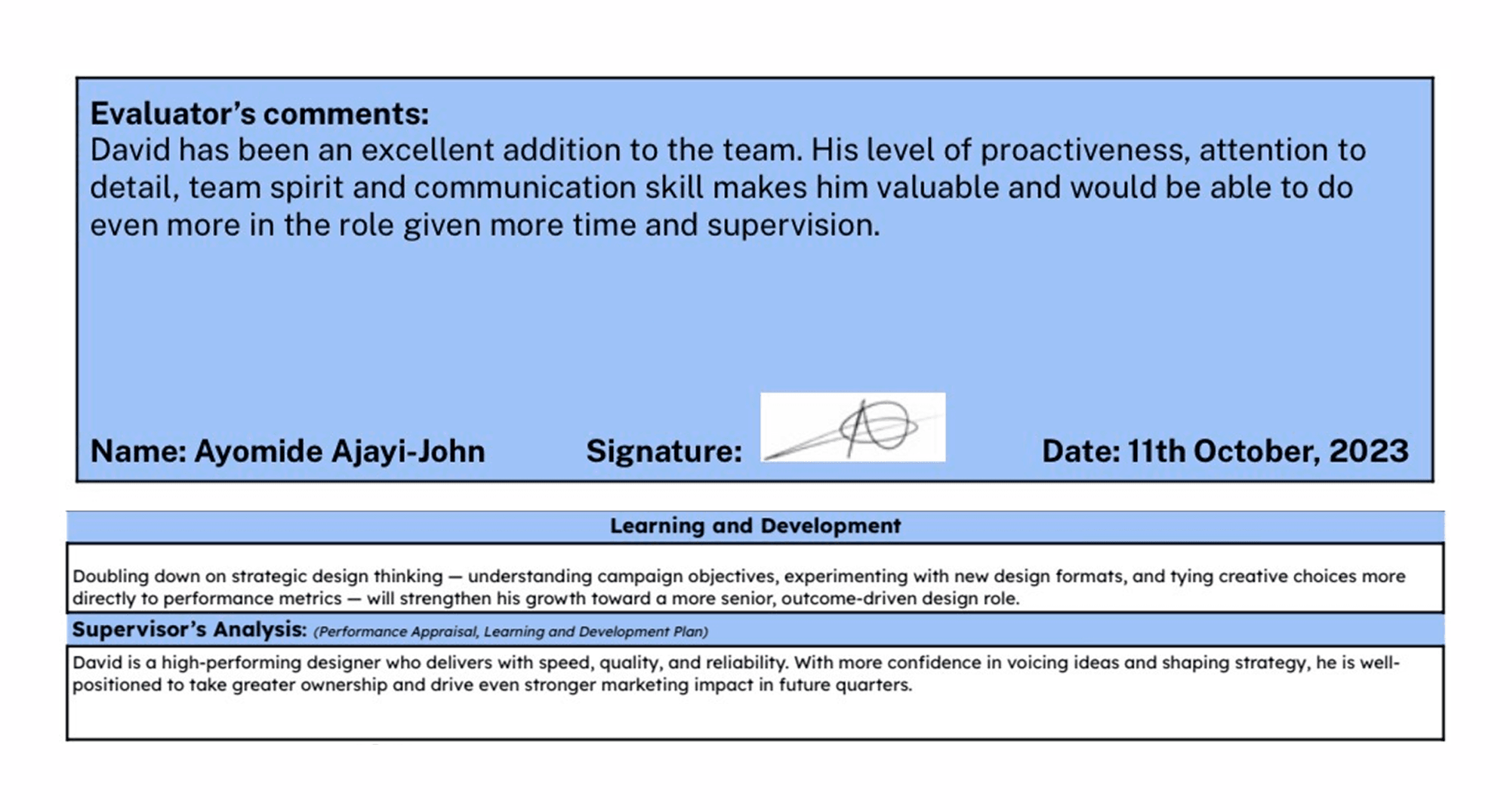

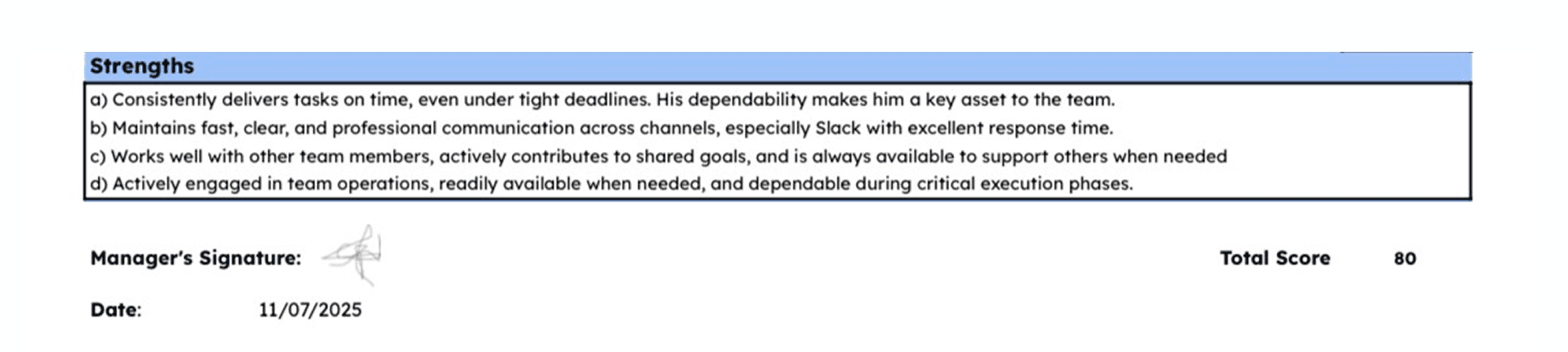
At some point, I stopped measuring design success by output and started measuring it by impact, not how many designs I produced, but how many decisions those designs influenced.
I became deeply interested in conversion because conversion is where design meets reality, and a design that does not convert is only aesthetic work, while a design that converts is communication that works under real human behavior.
This shift made me more aggressive about simplicity, hierarchy, and message structure, and I started removing everything that did not help a user understand faster because in performance environments, confusion is expensive, and every extra second of interpretation reduces the probability of action.
One of the turning points in my thinking came from sitting in cross-functional meetings where I was the only designer in the room, and I remember listening to performance marketers discuss CTRs, CAC, and A/B tests while sales teams broke down objections and conversion blockers in real time.
What stood out to me was how directly every conversation was tied to numbers because every creative decision had a measurable consequence, every message had a behavioral outcome, and every change either improved performance or reduced it.
That was the moment I understood that design was already part of the revenue system whether designers acknowledged it or not, and the only difference was whether we were aware of it.
Many people treat strategy as something that sits above design, but in reality strategy is embedded inside every design decision because choosing what to show is strategy, choosing what to remove is strategy, choosing what to emphasize is strategy, and choosing how fast something is understood is strategy.
When I design, I am constantly thinking about how information moves through a user's mind because users do not experience design as visuals, they experience it as decisions, where they either understand, trust, act, or leave.
One thing I have learned across industries is that clarity consistently outperforms complexity in performance environments because humans under attention pressure do not have time to decode ambiguity.
This is especially true in digital systems where users are constantly distracted, constantly comparing, and constantly deciding whether to stay or leave, so if a message is not immediately clear it is ignored, and if a design requires explanation before understanding it loses momentum.
This is why I have become very intentional about removing anything that does not contribute to instant comprehension.
Working across Sales, Marketing, Growth, Product, and Customer Success completely changed my perspective on design because each of these functions exposed me to a different layer of how decisions are actually made and how behavior is influenced inside a company.
Sales taught me how decisions are actually closed in real conversations where objections, timing, and trust determine whether a user moves forward or not, Marketing taught me how attention is earned, fragmented, and lost across channels where the same message competes with dozens of distractions, Growth taught me how small changes in messaging, onboarding, and funnel structure can produce disproportionately large changes in activation and retention behavior…
Each of these perspectives reinforced the same truth, which is that design is not a surface layer but a behavioral system that sits across the entire company and influences how perception is formed, how decisions are made, and how value is ultimately realized.
Today, I no longer see myself as just a Brand Designer. I see myself as someone who translates business intent into human understanding, and my job is not just to make things look better but to also make things work better.
That means every design decision must answer a deeper question, whether it improves clarity, whether it improves conversion, whether it reduces friction, and whether it increases trust.
Because at the end of the day, brands do not grow because they are visually impressive, they grow because they are understood quickly, trusted easily, and acted upon consistently.
Design is often treated as the final layer of communication, but in reality it is one of the first points where business intent becomes human behavior.
And once you understand that, you stop designing for just approval and you start designing for outcomes and revenue, and that is where design stops being art alone and becomes strategy in motion.